求相机位姿变换(2d-2d,3d-2d,3d-3d)——SLAM十四讲
·
2d-2d:对极几何
源代码:
都是我自己手搓了一遍,奈何ubuntu18.04突然卡死,文件都没了,只能用十四讲源代码了,可惜了我手搓的注释。
突然卡死的原因可参考这篇文章,真的有用!!!!卡死很多次后我都已经想换轻薄本了,结果解决了!!
#include <iostream>
#include <opencv2/core/core.hpp>
#include <opencv2/features2d/features2d.hpp>
#include <opencv2/highgui/highgui.hpp>
#include <opencv2/calib3d/calib3d.hpp>
// #include "extra.h" // use this if in OpenCV2

using namespace std;
using namespace cv;

/****************************************************
 * 本程序演示了如何使用2D-2D的特征匹配估计相机运动
 * **************************************************/

void find_feature_matches(
  const Mat &img_1, const Mat &img_2,
  std::vector<KeyPoint> &keypoints_1,
  std::vector<KeyPoint> &keypoints_2,
  std::vector<DMatch> &matches);

void pose_estimation_2d2d(
  std::vector<KeyPoint> keypoints_1,
  std::vector<KeyPoint> keypoints_2,
  std::vector<DMatch> matches,
  Mat &R, Mat &t);

// 像素坐标转相机归一化坐标
Point2d pixel2cam(const Point2d &p, const Mat &K);

int main(int argc, char **argv) {
  if (argc != 3) {
    cout << "usage: pose_estimation_2d2d img1 img2" << endl;
    return 1;
  }
  //-- 读取图像
  Mat img_1 = imread(argv[1], CV_LOAD_IMAGE_COLOR);
  Mat img_2 = imread(argv[2], CV_LOAD_IMAGE_COLOR);
  assert(img_1.data && img_2.data && "Can not load images!");

  vector<KeyPoint> keypoints_1, keypoints_2;
  vector<DMatch> matches;
  find_feature_matches(img_1, img_2, keypoints_1, keypoints_2, matches);
  cout << "一共找到了" << matches.size() << "组匹配点" << endl;

  //-- 估计两张图像间运动
  Mat R, t;
  pose_estimation_2d2d(keypoints_1, keypoints_2, matches, R, t);

  //-- 验证E=t^R*scale
  Mat t_x =
    (Mat_<double>(3, 3) << 0, -t.at<double>(2, 0), t.at<double>(1, 0),
      t.at<double>(2, 0), 0, -t.at<double>(0, 0),
      -t.at<double>(1, 0), t.at<double>(0, 0), 0);

  cout << "t^R=" << endl << t_x * R << endl;

  //-- 验证对极约束
  Mat K = (Mat_<double>(3, 3) << 520.9, 0, 325.1, 0, 521.0, 249.7, 0, 0, 1);
  for (DMatch m: matches) {
    Point2d pt1 = pixel2cam(keypoints_1[m.queryIdx].pt, K);
    Mat y1 = (Mat_<double>(3, 1) << pt1.x, pt1.y, 1);
    Point2d pt2 = pixel2cam(keypoints_2[m.trainIdx].pt, K);
    Mat y2 = (Mat_<double>(3, 1) << pt2.x, pt2.y, 1);
    Mat d = y2.t() * t_x * R * y1;
    cout << "epipolar constraint = " << d << endl;
  }
  return 0;
}

void find_feature_matches(const Mat &img_1, const Mat &img_2,
                          std::vector<KeyPoint> &keypoints_1,
                          std::vector<KeyPoint> &keypoints_2,
                          std::vector<DMatch> &matches) {
  //-- 初始化
  Mat descriptors_1, descriptors_2;
  // used in OpenCV3
  Ptr<FeatureDetector> detector = ORB::create();
  Ptr<DescriptorExtractor> descriptor = ORB::create();
  // use this if you are in OpenCV2
  // Ptr<FeatureDetector> detector = FeatureDetector::create ( "ORB" );
  // Ptr<DescriptorExtractor> descriptor = DescriptorExtractor::create ( "ORB" );
  Ptr<DescriptorMatcher> matcher = DescriptorMatcher::create("BruteForce-Hamming");
  //-- 第一步:检测 Oriented FAST 角点位置
  detector->detect(img_1, keypoints_1);
  detector->detect(img_2, keypoints_2);

  //-- 第二步:根据角点位置计算 BRIEF 描述子
  descriptor->compute(img_1, keypoints_1, descriptors_1);
  descriptor->compute(img_2, keypoints_2, descriptors_2);

  //-- 第三步:对两幅图像中的BRIEF描述子进行匹配,使用 Hamming 距离
  vector<DMatch> match;
  //BFMatcher matcher ( NORM_HAMMING );
  matcher->match(descriptors_1, descriptors_2, match);

  //-- 第四步:匹配点对筛选
  double min_dist = 10000, max_dist = 0;

  //找出所有匹配之间的最小距离和最大距离, 即是最相似的和最不相似的两组点之间的距离
  for (int i = 0; i < descriptors_1.rows; i++) {
    double dist = match[i].distance;
    if (dist < min_dist) min_dist = dist;
    if (dist > max_dist) max_dist = dist;
  }

  printf("-- Max dist : %f \n", max_dist);
  printf("-- Min dist : %f \n", min_dist);

  //当描述子之间的距离大于两倍的最小距离时,即认为匹配有误.但有时候最小距离会非常小,设置一个经验值30作为下限.
  for (int i = 0; i < descriptors_1.rows; i++) {
    if (match[i].distance <= max(2 * min_dist, 30.0)) {
      matches.push_back(match[i]);
    }
  }
}

Point2d pixel2cam(const Point2d &p, const Mat &K) {
  return Point2d
    (
      (p.x - K.at<double>(0, 2)) / K.at<double>(0, 0),
      (p.y - K.at<double>(1, 2)) / K.at<double>(1, 1)
    );
}

void pose_estimation_2d2d(std::vector<KeyPoint> keypoints_1,
                          std::vector<KeyPoint> keypoints_2,
                          std::vector<DMatch> matches,
                          Mat &R, Mat &t) {
  // 相机内参,TUM Freiburg2
  Mat K = (Mat_<double>(3, 3) << 520.9, 0, 325.1, 0, 521.0, 249.7, 0, 0, 1);

  //-- 把匹配点转换为vector<Point2f>的形式
  vector<Point2f> points1;
  vector<Point2f> points2;

  for (int i = 0; i < (int) matches.size(); i++) {
    points1.push_back(keypoints_1[matches[i].queryIdx].pt);
    points2.push_back(keypoints_2[matches[i].trainIdx].pt);
  }

  //-- 计算基础矩阵
  Mat fundamental_matrix;
  fundamental_matrix = findFundamentalMat(points1, points2, CV_FM_8POINT);
  cout << "fundamental_matrix is " << endl << fundamental_matrix << endl;

  //-- 计算本质矩阵
  Point2d principal_point(325.1, 249.7);  //相机光心, TUM dataset标定值
  double focal_length = 521;      //相机焦距, TUM dataset标定值
  Mat essential_matrix;
  essential_matrix = findEssentialMat(points1, points2, focal_length, principal_point);
  cout << "essential_matrix is " << endl << essential_matrix << endl;

  //-- 计算单应矩阵
  //-- 但是本例中场景不是平面,单应矩阵意义不大
  Mat homography_matrix;
  homography_matrix = findHomography(points1, points2, RANSAC, 3);
  cout << "homography_matrix is " << endl << homography_matrix << endl;

  //-- 从本质矩阵中恢复旋转和平移信息.
  // 此函数仅在Opencv3中提供
  recoverPose(essential_matrix, points1, points2, R, t, focal_length, principal_point);
  cout << "R is " << endl << R << endl;
  cout << "t is " << endl << t << endl;

}
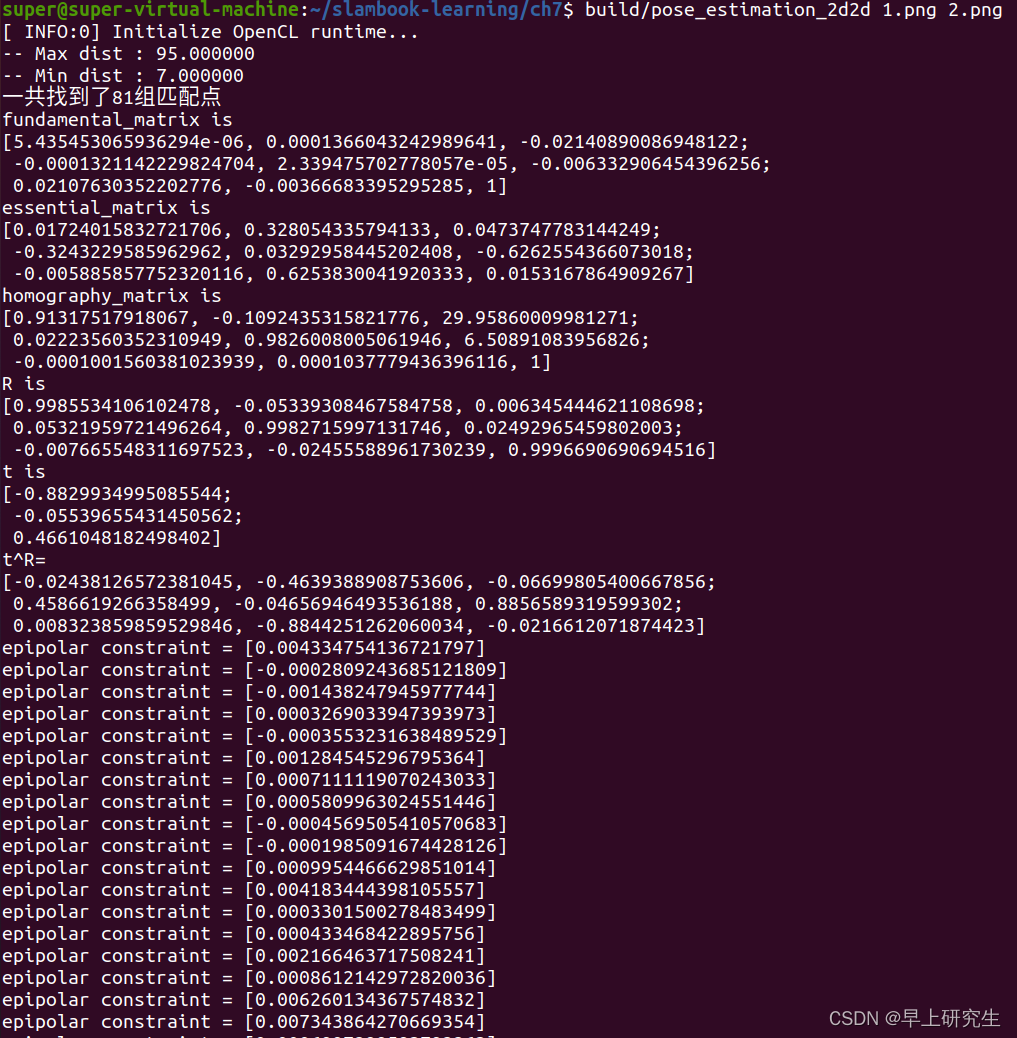
输入命令:
其中1.png和2.png都是彩色图。
build/pose_estimation_2d2d 1.png 2.png显示效果:
3d-2d:PnP
源代码:
#include<iostream>
#include<opencv2/core/core.hpp>
#include<opencv2/highgui/highgui.hpp>
#include<opencv2/features2d/features2d.hpp>
#include<opencv2/calib3d/calib3d.hpp>
#include<eigen3/Eigen/Core>
#include<sophus/se3.hpp>
#include<chrono>

using namespace std;
using namespace cv;

void find_feature_matches(const Mat &img_1, const Mat &img_2,
                        vector<KeyPoint> &keypoints_1, vector<KeyPoint> &keypoints_2,
                        vector<DMatch> &matches
                        );

Point2d pixel2cam(const Point2d &p, const Mat &K);

int main(int argc, char **argv)
{
    if(argc != 5)
    {
        cout << "用法错误" << endl;
        return 1;
    }

    //读取图像
    Mat img_1 = imread(argv[1], CV_LOAD_IMAGE_COLOR);
    Mat img_2 = imread(argv[2], CV_LOAD_IMAGE_COLOR);
    assert(img_1.data && img_2.data && "不能加载图像");

    //初始化
    vector<KeyPoint> keypoints_1, keypoints_2;
    vector<DMatch> matches;
    find_feature_matches(img_1, img_2, keypoints_1, keypoints_2, matches);
    cout << "一共找到了" << matches.size() << "组匹配点。" << endl;

    //建立3D点
    Mat d1 = imread(argv[3], CV_LOAD_IMAGE_UNCHANGED);  //深度图为16位无符号数,单通道图像
    Mat K = (Mat_<double>(3, 3) << 520.9, 0, 521.0, 249.7, 0, 0, 1);
    vector<Point3f> pts_3d;
    vector<Point2f> pts_2d;
    for(DMatch m : matches)
    {
        ushort d = d1.ptr<unsigned short>(int(keypoints_1[m.queryIdx].pt.y))[int(keypoints_1[m.queryIdx].pt.x)];
        if(d == 0)
            continue;
        float dd = d / 5000.0;
        Point2d p1 = pixel2cam(keypoints_1[m.queryIdx].pt, K);
        pts_3d.push_back(Point3f(p1.x * dd, p1.y * dd, dd));
        pts_2d.push_back(keypoints_2[m.queryIdx].pt);
    }
    cout << "3d-2d匹配点数量:" << pts_3d.size() << endl;

    chrono::steady_clock::time_point t1 = chrono::steady_clock::now();
    Mat r, t;
    solvePnP(pts_3d, pts_2d, K, Mat(), r, t, false);    //调用OpenCV中的PnP求解
    Mat R;
    cv::Rodrigues(r, R);    //r为旋转向量形式,用Rodrigues公式转换为矩阵
    chrono::steady_clock::time_point t2 = chrono::steady_clock::now();
    chrono::duration<double> time_used = chrono::duration_cast<chrono::duration<double>>(t2 - t1);
    cout << "用PnP求解用时为:" << time_used.count() << "秒。" << endl;

    cout << "R = " << endl << R << endl;
    cout << "t = " << endl << t << endl;

    return 0;
}


void find_feature_matches(const Mat &img_1, const Mat &img_2,
                        vector<KeyPoint> &keypoints_1, vector<KeyPoint> &keypoints_2,
                        vector<DMatch> &matches
                        )
{
    //初始化
    Mat descriptors_1, descriptors_2;
    Ptr<FeatureDetector> detector = ORB::create();
    Ptr<DescriptorExtractor> descriptor = ORB::create();
    Ptr<DescriptorMatcher> matcher = DescriptorMatcher::create("BruteForce-Hamming");

    //第一步:检测Orient FAST角点位置
    detector->detect(img_1, keypoints_1);
    detector->detect(img_2, keypoints_2);

    //根据角点位置计算BRIEF描述子
    descriptor->compute(img_1, keypoints_1, descriptors_1);
    descriptor->compute(img_2, keypoints_2, descriptors_2);

    //对两副图像中的BRIEF描述子进行匹配,使用Hamming距离
    vector<DMatch> match;
    matcher->match(descriptors_1, descriptors_2, match);

    //第四步:匹配点对筛选.找出所有匹配之间的最小距离和最大距离,即是最相似和最不相似两祖殿之间的距离
    double min_dist = 100000, max_dist = 0;
    for(int i = 0; i < descriptors_1.rows; i++)
    {
        double dist = match[i].distance;
        if(min_dist > dist)
            min_dist = dist;
        if(max_dist < dist)
            max_dist = dist;
    }
    cout << "匹配点之间最大距离:" << max_dist << endl;
    cout << "匹配点之间最小距离:" << min_dist << endl;

    //当描述子之间的距离大于两倍的最小距离时,认为匹配有误。但有时最小距离非常小,设置一个下限30
    for(int i = 0; i < descriptors_1.rows; i++)
    {
        if(match[i].distance <= max(30.0, min_dist))
            matches.push_back(match[i]);
    }
}

Point2d pixel2cam(const Point2d &p, const Mat &K)
{
    return Point2d(
        (p.x - K.at<double>(0, 2)) / K.at<double>(0, 0),
        (p.y - K.at<double>(1, 2)) / K.at<double>(1, 1)
    );
}
输入命令:
将彩色图和深度图放在和build文件同一目录下,使用下面命令
build/pose_estimation_3d2d 1.png 2.png 1_depth.png 2_depth.png 显示效果:

3d-3d:ICP
源代码:
#include<iostream>
#include<opencv2/core/core.hpp>
#include<opencv2/features2d/features2d.hpp>
#include<opencv2/calib3d/calib3d.hpp>
#include<opencv2/highgui/highgui.hpp>

#include<eigen3/Eigen/Core>
#include<eigen3/Eigen/Dense>
#include<eigen3/Eigen/Geometry>
#include<eigen3/Eigen/SVD>

#include<chrono>
#include<sophus/se3.hpp>

using namespace std;
using namespace cv;

void find_feature_matches(
    const Mat &img_1, const Mat &img_2,
    vector<KeyPoint> &keypoints_1, vector<KeyPoint> &keypoints_2,
    vector<DMatch> &matches
);

//像素坐标转相机归一化坐标
Point2d pixel2cam(const Point2d &p, const Mat &K);

void pose_estimation_3d3d(
    const vector<Point3f> &pts_1,
    const vector<Point3f> &pts_2,
    Mat &R, Mat &t
);


int main(int argc, char **argv)
{
    if(argc != 5)
    {
        cout << "用法错误" << endl;
        return 1;
    }

    //读取图像
    Mat img_1 = imread(argv[1], CV_LOAD_IMAGE_COLOR);
    Mat img_2 = imread(argv[2], CV_LOAD_IMAGE_COLOR);

    //初始化
    vector<KeyPoint> keypoints_1, keypoints_2;
    vector<DMatch> matches;
    find_feature_matches(img_1, img_2, keypoints_1, keypoints_2, matches);
    cout << "一共找到了" << matches.size() << "组匹配点。" << endl;

    //建立3D点
    Mat depth1 = imread(argv[3], CV_LOAD_IMAGE_UNCHANGED);
    Mat depth2 = imread(argv[4], CV_LOAD_IMAGE_UNCHANGED);
    Mat K = (Mat_<double>(3, 3) << 520.9, 0, 325.1, 0, 521.0, 249.7, 0, 0, 1);
    vector<Point3f> pts1, pts2;

    for(DMatch m:matches)
    {
        ushort d1 = depth1.ptr<unsigned short>(int (keypoints_1[m.queryIdx].pt.y))[int(keypoints_1[m.queryIdx].pt.x)];
        ushort d2 = depth2.ptr<unsigned short>(int (keypoints_2[m.queryIdx].pt.y))[int(keypoints_2[m.queryIdx].pt.x)];
        if(d1 == 0 || d2 == 0)
            continue;
        Point2d p1 = pixel2cam(keypoints_1[m.queryIdx].pt, K);
        Point2d p2 = pixel2cam(keypoints_2[m.queryIdx].pt, K);

        float dd1 = float(d1) / 5000.0;
        float dd2 = float(d2) / 5000.0;

        pts1.push_back(Point3f(p1.x * dd1, p1.y * dd1, dd1));
        pts2.push_back(Point3f(p2.x * dd2, p2.y * dd2, dd2));

    }

    cout << "3d-3d 匹配点对有:" << pts1.size() << "对。" << endl;
    Mat R, t;
    pose_estimation_3d3d(pts1, pts2, R, t);
    cout << "ICP via SVD 结果为:" << endl;
    cout << "R = " << endl << R << endl;
    cout << "t = " << endl << t << endl;
    cout << "R_inv = " << R.t() << endl;
    cout << "t_inv = " << -R.t() * t << endl;


    return 0;
}


void find_feature_matches(const Mat &img_1, const Mat &img_2,
                        vector<KeyPoint> &keypoints_1, vector<KeyPoint> &keypoints_2,
                        vector<DMatch> &matches
                        )
{
    //初始化
    Mat descriptors_1, descriptors_2;
    Ptr<FeatureDetector> detector = ORB::create();
    Ptr<DescriptorExtractor> descriptor = ORB::create();
    Ptr<DescriptorMatcher> matcher = DescriptorMatcher::create("BruteForce-Hamming");

    //第一步:检测Orient FAST角点位置
    detector->detect(img_1, keypoints_1);
    detector->detect(img_2, keypoints_2);

    //根据角点位置计算BRIEF描述子
    descriptor->compute(img_1, keypoints_1, descriptors_1);
    descriptor->compute(img_2, keypoints_2, descriptors_2);

    //对两副图像中的BRIEF描述子进行匹配,使用Hamming距离
    vector<DMatch> match;
    matcher->match(descriptors_1, descriptors_2, match);

    //第四步:匹配点对筛选.找出所有匹配之间的最小距离和最大距离,即是最相似和最不相似两祖殿之间的距离
    double min_dist = 100000, max_dist = 0;
    for(int i = 0; i < descriptors_1.rows; i++)
    {
        double dist = match[i].distance;
        if(min_dist > dist)
            min_dist = dist;
        if(max_dist < dist)
            max_dist = dist;
    }
    cout << "匹配点之间最大距离:" << max_dist << endl;
    cout << "匹配点之间最小距离:" << min_dist << endl;

    //当描述子之间的距离大于两倍的最小距离时,认为匹配有误。但有时最小距离非常小,设置一个下限30
    for(int i = 0; i < descriptors_1.rows; i++)
    {
        if(match[i].distance <= max(30.0, min_dist))
            matches.push_back(match[i]);
    }
}

Point2d pixel2cam(const Point2d &p, const Mat &K)
{
    return Point2d(
        (p.x - K.at<double>(0, 2)) / K.at<double>(0, 0),
        (p.y - K.at<double>(1, 2)) / K.at<double>(1, 1)
    );
}


void pose_estimation_3d3d(const vector<Point3f> &pts1,
                          const vector<Point3f> &pts2,
                          Mat &R, Mat &t) {
  Point3f p1, p2;     // center of mass
  int N = pts1.size();
  for (int i = 0; i < N; i++) {
    p1 += pts1[i];
    p2 += pts2[i];
  }
  p1 = Point3f(Vec3f(p1) / N);
  p2 = Point3f(Vec3f(p2) / N);
  vector<Point3f> q1(N), q2(N); // remove the center
  for (int i = 0; i < N; i++) {
    q1[i] = pts1[i] - p1;
    q2[i] = pts2[i] - p2;
  }

  // compute q1*q2^T
  Eigen::Matrix3d W = Eigen::Matrix3d::Zero();
  for (int i = 0; i < N; i++) {
    W += Eigen::Vector3d(q1[i].x, q1[i].y, q1[i].z) * Eigen::Vector3d(q2[i].x, q2[i].y, q2[i].z).transpose();
  }
  cout << "W=" << W << endl;

  // SVD on W
  Eigen::JacobiSVD<Eigen::Matrix3d> svd(W, Eigen::ComputeFullU | Eigen::ComputeFullV);
  Eigen::Matrix3d U = svd.matrixU();
  Eigen::Matrix3d V = svd.matrixV();

  cout << "U=" << U << endl;
  cout << "V=" << V << endl;

  Eigen::Matrix3d R_ = U * (V.transpose());
  if (R_.determinant() < 0) {
    R_ = -R_;
  }
  Eigen::Vector3d t_ = Eigen::Vector3d(p1.x, p1.y, p1.z) - R_ * Eigen::Vector3d(p2.x, p2.y, p2.z);

  // convert to cv::Mat
  R = (Mat_<double>(3, 3) <<
    R_(0, 0), R_(0, 1), R_(0, 2),
    R_(1, 0), R_(1, 1), R_(1, 2),
    R_(2, 0), R_(2, 1), R_(2, 2)
  );
  t = (Mat_<double>(3, 1) << t_(0, 0), t_(1, 0), t_(2, 0));
}
输入命令:
同3d-2d输入命令
显示效果:


聚焦RDK与具身智能,汇集机器人开发教程、开源案例和技术交流
更多推荐
 10
 0
- 0


 已为社区贡献3条内容

所有评论(0)